Monday, March 22, 2010

Egg and Bread

It is 4:45 am. I am in a cab to the Calgary Airport to catch my weekly 6am flight to Fort McMurray. I am craving Egg and Bread. There is something about travelling at hours when I know I should still be sleeping that makes me crave Egg and Bread.

But yes, I am grateful I am going to an airport and getting on a plane for a 58 minute flight, rather than the 10 hours it would take via bus.

Tuesday, February 23, 2010

The MoFA Innovation Challenge: Last Thoughts

As much as I enjoy writing about the “life” parts of my placement, I guess I should share with you a bit of a conclusion about the “work” I did.

And so I present a few closing thoughts on the MoFA Innovation Challenge. (Thanks to the fellow MIC/MoFA EWBers who helped shape these observations).

We recognized that MoFA innovations really fell into 3 categories:

1. Idea Generating

Idea generating innovations are defined as innovations that are designed to generate feedback or new ideas from the field level. This indicates that there is a desire in MoFA to provide more feedback and information upwards. These innovations include:

  • Suggestion Box – The innovation was to establish a suggestions box in the district office where staff can anonymously offer feedback or new ideas. The suggestions are read at each district meeting and a committee of staff are created to follow-up on actions that arise.
  • Farmer’s Day Survey – The innovation was to conduct a survey to uncover what elements of National Farmer’s Day are motivating for farmers and what kinds of prizes they would find encouraging. Currently, the same prizes are offered to farmers every year.
  • Workshop evaluations – The innovation was to create and use a general evaluation form to be filled out by field staff after attending a workshop. The evaluation form is used to inspire reflection on what works and what doesn’t at workshops.

These innovations were proposed by the District Directors, showing that there is room within the organization for upwards influence. However, there must be continual encouragement for staff members to use these tools. The emphasis on identifying and incorporating internal ideas into operations suggests that MoFA wants to be a learning organization and is open to improvement. Therefore, the challenge may come in having the resources available to implement proposed ideas.

2. Technical Projects

The second category of innovations are those which are technical in nature or agricultural field projects. These projects include:

  • Mango Nursery – develop a privately owned and operated mango nursery to offer farmers the opportunity to purchase mango seedlings should they wish to plant mango trees
  • No Tillage Demonstration – a demonstration of the benefits of applying no tillage technology compared with traditional land preparation techniques
  • Bee-Keeping Demonstration – a demonstration of the benefits and risks of bee-keeping as a business

These projects were driven by AEAs who saw a need or opportunity for additional extension services. Approved projects were typically not new to MoFA; field staff determined the projects were relevant to farmers, but the projects didn’t currently have a source of funding. This implies that field staff are in a position to develop and promote field level interventions that are relevant for farmers.

3. Administrative Improvements

The third classification of innovations is administrative or managerial improvements. These projects include:

  • Supervision Scheme – This innovation addressed the challenge that that district management rarely visits the field to supervise. The innovation was to provide prizes for staff that visit the field most often and regular tracking of improvements to supervision over time through anonymous surveys.
  • Job Description Review – This innovation addressed the challenge that there are imbalances in the distribution of work. The innovation was to organize a discussion on how workload is distributed between officers in a district.
  • Internet Connection Study – This innovation addressed the challenge that district directors spend a disproportionate amount of time driving to the regional capital to submit reports. The innovation was to compare the prices of various methods that can be used for connecting district offices to the internet and to measure the amount that each district can save by connecting to the internet, thus saving on expenditures for gas/phone calls.

The presence of this category of innovations implies that MoFA is identifying ways to improve operations. It can be argued that these are not innovative, but rather tasks that should be completed normally. Regardless, they have been identified as important tasks to complete, which should be taken as a positive indication of MoFA’s interest in improving the effectiveness of its operations.

The types of innovations highlighted that field staff are in the best position to evaluate and replicate successful technical projects.

Many of the innovations that came from the MoFA Innovation Challenge were not new or unique, but were activities that were being conducted elsewhere in the district or region (either funded through MoFA or other non-governmental partners). The MoFA Innovation Challenge was used as a source of funding to further extend these programs. In particular, mango nursery and bee-keeping projects are currently being funded in Lawra district as part a program implemented by the Japan Development Agency (JICA). Two field staff, who were not in the participating operational areas, identified these projects as something that would be of interest and beneficial to one of their farmer groups. Through the application of funds from the MoFA Innovation Challenge, these projects are now underway. Similarly, Wa West used MoFA Innovation Challenge funding to conduct a no-tillage demonstration, which was also conducted in other districts in the Upper West Region through various programs.

Despite the fact that the field staff projects were not novel, the willingness of the field staff to propose and take on additional projects highlights the fact that they are people who are dedicated to working for the betterment of their farmers. The use of funds for project-based extension efforts, to provide the appropriate inputs and learning-through-doing, highlights the importance of this approach. Field staff did not propose seminars or learning modules for their farmers, but tangible projects. They have worked alongside farmers to help ensure the appropriate training and actions are taking place.


What we learned from the MIC

1. High cost effectiveness can be achieved when resources are directly available to district staff.

The following two projects cost less than $15/farmer. When targeted at the field level and used properly, minimal resources can open up large opportunities for beneficiaries.

  • Bee-keeping – The costs included hives which are $45 (for local basket) or $192 (for more durable version), two pairs of bee-keeping protective clothing and a four weeks training program. This allowed 16 beneficiaries the opportunity to access a new source of income.
  • Mango nursery – The cost was $120 which placed an emphasis on using local methods and materials for the nursery. This allowed 30 farmers the opportunity to acquire the skills and resources required to run mango nurseries.

2. Competition for most innovative district was not an incentive. What motivated people to develop innovations was the opportunity and resources provided to execute on projects.

Based on the monitoring and evaluation conducted, the promise of awards or recognition for the most innovative projects and/or district did not seem to be a driving factor behind the conception or execution of the innovators’ work. The projects implemented using the innovation fund were driven by opportunity and resources, which came in the form of both funds and encouragement to take action. This demonstrated that staff are motivated to address these problems because they care about their farmers and want to see MoFA become a more effective and efficient organisation. The ownership to realize success comes more strongly when the program design is done largely in the district.

3. Regular checkpoints throughout the project lifecycle help to ensure maximum results are obtained from the MoFA Innovation Challenge.

Many of the innovators were very independent in implementing their projects. They needed little to no coaching and proactively kept appropriate records for their project implementation. However, this was not the case for all innovators and innovations. It is recommended that, in the future, the innovator set a timeline for the implementation of the project. From that original timeline, checkpoints can be scheduled at regular intervals. This allows the innovator to retain control over his or her schedule, but gives additional accountability to an external party. Unfortunately, the ability to play this management role is not widespread within MoFA. Therefore, until MoFA improves its management capacity, it is necessary for an outside party such as EWB to play this role.

4. Management needs to oversee the Innovation Fund to ensure that application and selection processes continue efficiently.

In addition to the individual guiding and coaching, EWB oversaw the overall process of announcing the innovation fund, accepting applications, and coordinating a selection committee. In the absence of this role it is expected that the implementation of the innovation fund would not have occurred efficiently.

Overseeing of the innovation fund is also essential to keep track of common challenges across innovators and share problem solving processes to continue to develop field staff capacity to innovate..

Conclusions

The MoFA Innovation Challenge expected three outcomes to emerge. The results in each of these outcome areas are summarized below.

1. A selection of innovative ideas, best practices and projects which can be scaled up.

Currently these innovations are still being implemented. Some innovations have not, to date, been implemented to completion because the innovators faced unforeseen challenges e.g. not enough time to implement demonstration plots due to other extension duties that need to be completed.

MoFA Management and EWB are still supporting the districts to implement innovations to completion. Once the implemented innovations reach completion and a period of time passes (6 – 12 months), the results of these innovations will be evaluated by MoFA and shared with other districts and the regional level. Ideally, those innovations which are visibly successful will be adopted in other districts.

For the field level innovations, such as bee-keeping demonstrations, it is expected that MoFA will share the results with donors when they are conducting feasibility studies.

2. Increased capacities of district level staff to problem solve and innovate, built through experiential learning.

This experience provided 14 district staff with the opportunity to problem solve, create an idea and implement their innovation. The learning for each staff varied, depending on their abilities to problem solve, innovate and implement. For all, the learning was valuable. However, for the field staff the learning was much greater as this was among the first time this experience was provided to them. The issue of lower capacity of field staff was managed through coaching and guidance from EWB.

3. Demonstration of a model that provides more resources, incentives and opportunities to districts to innovate and drive change.

The model successfully demonstrated that districts are able and well placed to innovate and drive change. Based on the four main learnings about the model, the following conclusions can be drawn about the model.

1. A small amount of funding needs to be made available directly to the district to ensure cost efficient interventions.

2. The funding should be unrestricted to ensure the districts have ownership over the successful use of the funding.

3. Management needs to guide and motivate field staff through the process of analyzing problems, developing ideas and learning from their experiments.

4. Management needs to oversee the Innovation Fund to ensure that application and selection processes are efficient and that learning can be shared across innovators.

In the end, I’m not really sure what’s next for the MoFA Innovation Challenge. I would love to see it take shape, grow and be redeployed in a better format. That would be entirely awesome.

Sunday, December 13, 2009

Wow!

A little behind on posting details of the last month. There was a lot to be done in the last couple of weeks in Lawra that there hasn't been time to sit down and write.

In the meantime, photos from my short vacation (with the other girls) in Cape Coast.

http://www.facebook.com/album.php?aid=177957&id=641571969&l=c64b95a263

I'm in Accra now, leaving the country in 3 days … WOW!

Thursday, December 10, 2009

Goodbye, Part I: Leaving the Upper West

The Last Saturday: Friends

Ugh, Saturday morning I woke up definitely sick.

Mishellen came over to do my laundry, as she does every Saturday (I will miss her, but then again, in Canada, I will have a washing machine), and I just slept. A little while later Mabel (Mishellen’s sister) and Mark (their neighbor) showed up. I let them in, but still slept. And then my friend Zion arrived to visit (from Wa) for the day.

Four visitors, but I did not feel anywhere near alive.

I continued to lie on my bed coughing and half sleeping while M3 (Mabel, Mishellen and Mark) played with my computer, camera and iphone and Zion read. I realized that they were all intent on spending the day with me, so I dragged myself out of bed, showered and resolved to make it through the day.

We headed into town on a mission: to take pictures of Lawra and to buy a few things I needed to gather for my family. The pictures morphed into a video, with continual narration by M3. The commentary was hysterical. We stopped in a couple of the shops I frequent, and the shop owners humored them by doing what they requested and let them run through their stores videoing and conducting interviews. I couldn’t stop laughing.

I successfully completed my shopping, and we ended our trip by picking up food for lunch. (Side note: There were pineapples in Lawra on Saturday!).

The kids eventually went home.

For dinner I went to the Lawra Chief’s palace, where Ruth (Zion’s aunt) prepared TZ for us. I don’t have the same strong feelings against TZ as some of my fellow volunteers do (not naming any names, you know who you are), but I can’t say that I’ll miss it. Ruth was happy that she was the one to prepare my last TZ (for now), and was very adamant that she will have the opportunity to do so again in the future. I’ve enjoyed being a welcome and fairly regular guest in the palace (meaning, I think I’ve been there twice), and will miss the friends I’ve made there.

After dinner the plan was to go for one last round of minerals, but for some unknown reason, all the bars in Lawra were closed. Lawra is known as one of the “night spots” of the region, so this was strange for 8pm on a Saturday night. Alas!

Feeling tired and sick, but very happy, I crawled into bed. As Mabel said: “This was the best day ever”.

The Last Sunday: Packing and Gifting

My last Sunday was a lazy day. I pretty much just gave everything I had away to Mabel and Mishellen. They were soooooo excited to have a basket full of new clothes. What girl wouldn’t be?

Alison (the VSO volunteer from Toronto) came over as well. I love her and am sad there wasn’t more overlap in our placement. She is absolutely amazing and I wish her all the best in the remainder of her time in Lawra.

LAST DAYS 067 LAST DAYS 010

The Last Monday: Cough, Cough & Goodbye MoFA

I woke up still feeling super sick. Did I even sleep? I’m not sure. I looked at the clock and decided to not bother getting up. Eventually I mustered the strength to go to town and buy antibiotics. Must kill the bugs! I then went to work, so I could officially say goodbye.

I had a good discussion with the Director to transition out EWB from the Lawra District, and then at the end of the day, received my official goodbyes and thank you gift from MoFA. By this point I had no voice, which I was fortunate because if I had to say some something I probably would have cried.

On the way home from work I ran into a group of girls from Lawra Secondary School. They decided they wanted to taunt me with the ‘Nasa Po’ (white lady song). I agreed, on the condition that I could film them. Teenage girls in front of a video camera are no different in Ghana than they are in Canada. Full of cheese and hysterics.

My girls (Mabel and Mishellen) came over one last time and walked around my apartment and picked up everything that I hadn’t yet packed and asked if they could have it. In the end, they went home with yet another bag of goodies.

The Last Tuesday: A GOOD day in Wa

Monday evening Anna, a VSO Volunteer, called me to say she was driving to Wa Tuesday morning, would I want a ride? Um, yeah! Private lorry. Most definitely. So after a few more teary goodbyes in Lawra, I had a dust-free, AC-ed trip into Wa, direct to Kunateh Lodge. Because I was arrived in the morning, before everyone checked out, there was only one room left for me. I don’t normally spend the extra GHC5 to get a self-contained room (toilet in room, instead of communal washrooms), but I had no option, and hey, it’s my last night in Wa, let's have a little bit of luxury. (It turned out to be a good thing as I spent most of the night, quite literally, coughing my insides out).

After I deposited my many things in the room I headed out for one last stroll around Wa.

Beans and plantains for breakfast? Why not?

Next on the agenda was Trends Internet Cafe to visit Hamida. Hamida has to be one of happiest people I have ever known. When I arrived at the cafe she informed me there was no internet service. I said it didn’t matter, I was coming to see her. She was more than delighted, and we just hung out. I then gifted one of my USB keys to her, my nicest one too. She loved it. While I was there a new VSO volunteer came in. He was doing a very short placement at the Regional MoFA office, but had no background knowledge about MoFA. I was able to spend an hour with him and shared all I knew, and many of our basic EWB resources with him. It was nice to be able to sit and share the little that I had learned about how to effectively (?) operate as an outsider in MoFA. I felt that this was a nice way to (unofficially) end my placement.

DSCF7983

Feeling a little sleepy and in need of some rest, I started to head back to the Lodge. Jody called to let me know about my bus logistics for the day. As I was talking to Jody I sat on a bench in some shade. I group of little girls, probably kindergarten age, passed by. They stopped and watched me for a little bit, then spontaneously started climbing on me and giving me hugs. Actually, they couldn’t stop giving me hugs. I let them. I acknowledged the fact that I didn’t really have anywhere to go, and in Canada, I’m pretty sure I won’t have four little kindergarten girls showering love on my. I decided to enjoy this moment. We took pictures and laughed together. As I eventually tried to leave, they wouldn’t let me. The all wanted more hugs. I gave them. I picked them up and gave them hugs. Then one girl started to climb me like a tree; I nicknamed her Monkey Girl. Then the girls started arguing about which one of them should really be the Monkey Girl. I should note that I was totally amazed by their English, it was far better than most adults I had met in Wa. As I started heading down the street, they came with me, holding my hands and legs. Apparently their homes were in the same direction I was headed … we got to one side street and I was told I was coming with them to see their houses and meet their mothers. Why not? I went. We got to the one house, and I was hesitant to come into the compound. A neighbor saw my hesitation and came over to greet me and told me to go on in and meet their mother. And so in I went. The girl got her mother and they all started talking to her at once. I was slightly bewildered, but smiling. I greeted their mother, and then a younger sister came and also wanted a snap (her photo taken). Her mother told me it was ok. I said goodbye again to the girls, and as they started to follow me, their mother thankfully told them to stay.

DSCF7991 DSCF7986

I went back to the hotel, had a shower and a nap. I realized it was starting to get dark out, and remember the last time I was in Wa after dark (and got terribly lost!) and decided to head out for some dinner. By the time I reached the vendor I wanted to go to, it was pretty much dark. I successfully made it back to my hotel, and settled down in front of the tv with my dinner. While I’ve stayed in this place before, I never really bothered to watch TV / had a room with decent reception. It was really strange to see Christmas commercials on TV. TIGO’s Santa wore a blue suit (TIGO’s color).

The next morning I headed to the bus station with all my luggage; too much luggage. Jody had pre-booked the ticket for me from Bole, and so there was a little confusion about why I didn’t have a physical ticket. Eventually, they figured everything out and the white lady’s luggage was accepted on the bus. And so I left Wa.

For additional photos of my last days in the Upper West see: Upper West Photos!

Tuesday, December 8, 2009

Sunday, December 6, 2009

Farmer’s Day Photos

Introduced by the Ministry of Food and Agriculture, National Farmers' Day was organized as a day’s activity for the nation to honor its hard working farmers who excelled in their contribution to improve the agricultural sector with certificates and prizes. In 1988, the first Friday of every December was set aside by the government as Farmers' Day and is celebrated as a statutory Public Holiday. (Source: our favorite friend, Wikipedia)

Again, apologizies for just posting a link to photos, but it's the easiest way to keep the masses happy for now.

http://www.facebook.com/album.php?aid=176131&id=641571969&l=7e04d6afd3

Friday, December 4, 2009

25th Annual Farmers’ Day

What is Farmer’s Day?

Farmers’ Day was instituted in 1984, after a particularly bad period of drought and hunger the previous year, when it hardly rained, there was a very bad harvest, widespread bush fires, and many Ghanaians starved. to compound the problem, Nigeria deported a great number of Ghanaians who were working in that country, who arrived to swell the population …

… In 1984 … it rained. The harvest was much better, and so Farmer’s Day was instituted to thank the hardworking and often un-rewarded farmers for their efforts. It was not initially a holiday, though. Indeed, I believe it was not until 1995 that it was declared a national holiday.   - Bradt Guide to Ghana

Lawra District Farmers Day

IMGP8442

Each year there is a theme for the National Farmers Day Celebration. This year it was “Accelerated Agricultural Modernization for Food Security and Economic Transformation”. In meetings preparing for the event, MoFA staff was enthusiastic about the theme. Based on my observations of the Upper West, however, I struggle to see how this theme is entirely relevant when people are struggling with even the motivation to get out and put a sincere effort into their farms, let alone a modernized approach. Maybe I’m thinking about this with too much of my Western hat on. When I think modernization I tend to think of the British Agricultural Revolution, Jethro Tull and Andrew Meikle, and the Green Agricultural Revolution of the 20th Century. To many of the farmer’s here though, I guess modernization is using long handled hoes as opposed to bending over for hours laboring in their fields with short handles, crop rotation … anyway …

As a woman on the MoFA staff, the Director was adamant that I participate with the women in preparing all the food for the event. The people of the host town were responsible for preparing and providing food and drink for all the farmers and visitors for the day. MoFA was responsible for providing food and drink for all the dignitaries and officials for the day.

All week I’d been feeling slightly under the weather, but not yet entirely sick. Tired, but resolved to participate in Farmer’s Day I joined Mariko, Felicia, Asana, Mercy, and  Elizabeth to shop for the ingredients. I think about the times my mom and I worked together to prepare large volumes of food for weddings, parties, etc, in Canada. One trip to Costco, another trip to Sobey’s and maybe a Wal-mart trip and we were good to go. The ladies had gone to Wa the day before to buy the food containers, napkins, utensils, and some of the vegetables; the men were headed out to slaughter the animals; we were headed out through Lawra to get more vegetables.

Walking around Lawra, I realized I was starting to not feel very well at all, but again, determined to participate fully in the preparations, just kept it to myself. While we were waiting for, well, I don’t remember now what exactly we were waiting for, probably the truck, I managed to sneak a nap on a bench at Elizabeth’s house. We eventually got the truck loaded up and headed out to Toupare.

When we arrived there was no water immediately available for us at the site. Someone managed to find us a giant poly tank, and then we solicited the help of the local school girls to fill it for us. 

IMGP8460IMGP8468  

We then started our labors …

IMGP8459 IMGP8478

While were supposed to be focusing on preparing food for the Farmer’s Day events, we were also required to make lunch and dinner for the staff who were starting to get things set up. To be honest, at this point I realized that I was getting tired of Africa. Just how much cooking do we have to do? How come everything takes so long? And I was hungry. Really really hungry. I will fully admit to sneaking / stealing extra fried plantains before we ate them, and after my share was finished as well.

I spent part of the afternoon chopping okre and tomatoes, and then, well … it was nap time again for me.

The women were sleeping over at the school so they could be up in the early hours of the morning to start preparing the food. However, all the agric staff agreed that I needed to go back to Lawra and sleep in my own bed for the night. I was at the point where I wasn’t going to disagree.

After coughing and struggling to breathe through most of the night I managed to get myself out of bed. Deciding I needed breakfast, I biked into town. I still remember how cold I felt. I’m sure it was about 18 C, but had my hoodie sleeves pulled down over my hands and wishing for mittens and a scarf. Everyone I passed laughed at how cold the white girl looked. I still don’t understand the idea that just because I’m white and from Canada I should be able to tolerate the cold. I don’t do well with Canadian winters, and I don’t do well with the cool season in Africa.

The bike ride there and back was more than exhausting. I knew for sure I was sick. Sigh …

I arrived at the MoFA office on-time, only of course, we weren’t going to leave for many more hours. I sat on the front steps watching everyone attempt to load the truck. Director asked me why I was enjoying myself so much, and I replied that I felt like I was watching a sitcom. He sat down beside me for a few minutes and then started to laugh. He agreed with me. He’d never really taken a step back and just look at how ridiculous everything must look to an outsider. After a good shared laugh, he asked me to take pictures and film some of it. I appreciate the fact that he had a great sense of humor.

Nap time again.

Director came and found me sleeping in the conference room on a bench (I must note that I am quite proud of the fact that I have learned how to successfully nap on benches. I see this as a very valuable and very authentic African skill). I guess naps at 8:30 am mean you are sick. I had to beg and plead to be allowed to continue to participate in Farmer’s Day. Fortunately, my argument that this would be my first and last Farmer’s Day was substantial enough and I was allowed to continue on with my quasi-participation.

Time passes …

The truck has not yet returned.

More time passes.

The truck has died somewhere along the way.

We rounded up some motos and got the rest of the officers out to the site, and Director found a truck from the District Assembly that had not yet left. They came to pick us up, and then we went to pick up the minerals (pop). It is now 10 am. (Note the sign above, wasn’t this event supposed to start at 8am prompt?).

As soon as we arrived, the event got started. I mean, you can’t start the Farmer’s Day celebrations with out the Director of Agric, can you?

My role as official photographer and videographer commenced. And of course, there wasn’t a cloud in the sky. I was really focused on capturing the images of the day, I didn’t may much attention to the speeches that were going on. However, one thing stood out to me. Instead of simply focusing on continued support for the farmers, the Director expressed his disappointment of the efforts of the farmer’s this year. They had received plentiful support, but did not act to the fullest of their capabilities in tending to their crops, etc. He made a very passionate plea to the people about responsibility and accountability for the future of their families and of the area. I appreciated this.

The inspection of crops and livestock reminded me of the Calgary Stampede. The Agric officers and District Assembly staff walked around to see the exhibits people had put together. There were no prizes offered for the exhibits, but you could see the pride people had as they brought forward their biggest gourds and finest beans.

After the festivities had finished, I ate with the officials. I actually felt really awkward about this, since the other MoFA volunteer was serving, but I guess the plan was to get me fed and home to bed as soon as possible. Director put me in the first District Assembly truck that was leaving.

I showered and crawled into bed.

And so ended my one and only Farmer’s Day, again, entirely grateful that I am not a farmer.

For more photos from the Lawra District Farmer’ Day, held in Toupare, please see: Farmer's Day Photos

Tuesday, December 1, 2009

What’s Next?

Agriculture is not my thing. I don’t think I really needed to come to Africa to learn that. But what I did need to come to Africa for was to give back the little that I could give to people.

Each year on the Vinyl Cafe, they award an “Arthur” to a small handful of people who have done seemingly insignificant, regular, yet extraordinary acts of kindness in their life. One of the 2009 Recipients, Carmel Moody from Vancouver/Camrose, said the following:

“Everybody has been given something, and if you can find what that is, and you if can find the venue to channel that and to give that back…just walk out your front door, and you’ll see somebody that might need what you have … do that, take that risk … it will be amazing what happens…”

I have a few days left in Lawra, a few more in Ghana, and then I will be back in Canada. I hope that I can recognize what it is that I have to offer my community in Canada, and that I will have the courage to do so.

Wednesday, November 25, 2009

Not Quite Toilet Trained

So, apparently in the evening while we’re not at the office goats come inside to use the washroom. It seems as if they know which room is the washroom, but they haven’t quite yet figured out how to use the toilet.

Note: This has happened on more than one occasion!

DSCF7370 DSCF7371

Tuesday, November 24, 2009

Disappointment

Today Mariko and Dangana went to check-up on our dry-season vegetable farming. I usually go on these visits too, as this project was part mine as well. This week, the new National Service person was to take my seat on the back of Dangana’s moto, so I was axed from the trip. To be entirely honest though, I wasn’t heartbroken. Heading out to field at 630am is not exactly my favorite thing to be doing.

Last week when we went to visit many of the seedlings were wilting and facing imminent death. The rains have officially stopped in the north now, and it appears that the farmers were not remembering to water. We spoke with the farmers and once again explained the importance of watering early each morning, and then in the evening. Even if they were busy with their harvest, they needed to take time to tend to their nursery.

This week, everything was dead. Dry season farming project: over. At least in this community, at least for now. We invested a lot of time into supporting the farmers. We invested seeds. The farmers pooled GHC20 and purchased more seeds and started a second phase of their nursery. Now, everything is dead.

What could we have done differently? Why couldn’t they remember to water?

The farmers cleared land for the nursery, tended the seedlings, cleared land for the farm, built a wall, invested their own money, and yet they couldn’t remember to water once harvest got busy.

So frustrating. So disappointing.

DSCF6876

Last week: seedlings starting to wilt …

A Weekend Affair with the Garden City

Wednesday: Oh, Wa!

On Wednesday I travelled to Wa, so that I would be able to catch my very early morning bus on Thursday to Kumasi. I almost missed the bus to Wa because, well, it was almost on-time, and I was operating on Ghanaian-time! Fortunately, I rounded the corner just as it was beeping its horn for last call. This was my first time taking the MetroMass to Wa (my schedule usually puts me on a tro), and it such a great experience (i.e. breathing space and slightly less dust).

Once I arrived in Wa, I made my way to Kunateh Lodge, where I was greeted enthusiastically by the owner. It’s nice to be a regular, and to be welcomed as a friend. Next on the agenda was to connect with Allison (the Canadian VSO in Lawra), who was in Wa already for meetings, and was kind enough to pick up my bus ticket for me (for most long-hauls you need to buy the ticket at least a day in advance). While I was waiting for her, I headed to Trends Internet to download the big files I don’t dare try on my modem. Shortly after I arrived, Allison and Melanie (an Australian VSO in Wa), walked through the door of the cafe. They hadn’t yet received my message indicating that I was there, but the good Ghanaian fate that seems to be in abundance here led them right to me. The network was down (of course), so we spent time chatting together, and with the girls who work at/hang out at Trends. Turns out we’re all friends through each other. Allison and Melanie had to run to a movie, but I stuck around in hopes that the network would come back up, chatting and laughing with Hamida (my best “Wa” friend) seemed like a better alternative than aimlessly wandering the city. And, in good time service came back up, and I was able to take care of some business, finishing just as it was “Lights Out!”. Hamida asked if I was ok to walk back to my lodging in the dark, I assured her I was.

I was wrong.

Most of Wa’s intersections are traffic circles or multi-point junctions, which, even in the daylight, get the best of me. With no street lights, no stars, no moon, and no flashlight I found myself going up and down every street but the right one. I would make my way back to the District Assembly each time, where I knew the street I needed branched off from, but for some reason I just couldn’t find the right one.

I called Hamida. She couldn’t stop laughing at me, but said she’d come and meet me. While waiting for her I figured out what road I really should be walking down, and called to tell her she could turn back.

DSCF5379

Thursday: Gluttony and Love

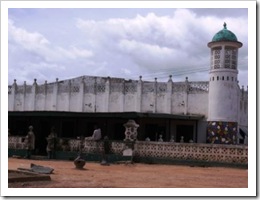
I knew Wa was a Muslim city, but I didn’t fully realize how dominant Islam was until I was up at 430 am, and simultaneously heard about 10 different “Calls to Prayer” in the area right around my lodge. Hearing this, I was retrospectively amazed that I’ve always slept right on through during all my other stays in Wa.

DSCF6969 DSCF5591

I made my way to the bus station, catching a ride with someone headed that way. (Note to self: don’t take rides from strangers in Canada).

I checked out the buses that were boarding; they were both Tamale buses. The dark bus was mine, so I found myself a nice waiting spot. While I was waiting several people came up to me to check and make sure that I wasn’t supposed to be going to Accra or Tamale, that I was really sure that the empty bus was mine, that yes, I was going to Kumasi. While I was waiting I debated whether or not I should have breakfast. There was a lady making egg-bread, and I was kind of hungry, but decided against the food since I didn’t know when the first bus stop would be, and I didn’t want to impair my sleeping ability. At this point it was about 530am.

Once on the bus, I realize I was fortunate enough to be sitting next to a very nice lady and a cute little baby. She was incredibly well behaved, and spent most of the ride just staring at me, or playing with the handles of my purse.

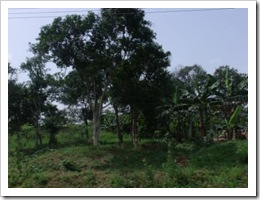
The further south we headed, the more amazed I was at the differences in the landscape. Green! Lush! Palms! Ferns! Green! I am not exaggerating to say that I was filled with complete joy and happiness just by watching the countryside change. It was a form of beauty I have not seen since my arrival in August.

DSCF7088 DSCF7096

As we drove into Kumasi I was awed by what I was seeing. Home building centres (Ghanaian equivalents of Rona or Home Depot), engineering firms, tall buildings, houses and houses and houses, people, cars (and nice ones too!) …

Do I believe in love at first sight? I do now. I LOVE Kumasi. I was filled with a sense of excitement and happiness, that well, I can’t explain. I love, love, love, love, love Kumasi. I understand that part of this love comes simply from the fact that this is the first city that I’ve stepped foot in since August (I was only in Accra for 12 hours, most of which was spent sleeping, and Tamale doesn’t really do anything for me). But I am convinced that part of it was really just that I love Kumasi. Through my eyes, Kumasi is a hybrid of Maadi, Egypt and Abu Dhabi, United Arab Emirates, that is situated in a rain forest type environment.

I got off the bus and realized I had no idea where I was supposed to go. No messages from Carissa. There were two members from the UWR MoFA Regional Office on the bus as well, and they were hesitant to leave with no plan. I decided to just make a plan: Chose a direction, start walking. Africa has definitely changed my concept of “planning”.

Carissa eventually called me and confirmed where we were staying (she had sent a text, but in Upper West style, I never got it). So, I jumped in a taxi, and headed to the Guestline Lodge. I was able to secure us two rooms, and headed upstairs for a shower and some post-bus relaxation.

My stomach eventually realized it had eaten very little, so I decided to venture out some food. I wound up at a supermarket, where I proceeded to purchase anything but a nutritious lunch. Chocolate cookies, KoolAid, shortbread …

I am NOT exaggerating when I say that the first bite of all-butter, Scottish shortbread almost brought tears to my eyes. I don’t think eating a cookie has ever been such a full-bodied experience for me. (Note: this same experience was had by both Nadia and Claire when they tried the shortbread a few hours later.)

It was at this point I discovered that the family living next door to the hotel had unsecured wireless internet, which, ironically enough, was faster than the broadband in Wa. Go Figure.

Claire and Nadia arrived. I was ecstatic to see them. We headed out for dinner, Carissa, who had come to Kumasi a day earlier to do some work at KNUST, joined us. We had an awesome dinner and an awesome catch-up.

Friday: Kuapa Kokoo - Fair Trade Cocoa

Friday’s agenda was the true purpose for our visit. Claire decided she wanted to put together a little documentary on fair trade, and arranged a visit for us with Kuapa Kokoo, Ghana’s only Fair Trade Cocoa company, based in Kumasi. In 1995, the Ghana Cocoa board underwent liberalization, opening up the market, allowing for the formation of additional cocoa companies, one of which was Kuapa Kokoo, which decided to target the market through fair trade channels.

On the way to Kumasi Claire called the man at Kuapa who she had been communicating with, only to learn that he was called out of town last minute. She was given the name of another individual, who we weren’t able to touch base with. Thus, Friday morning we headed to the office, fingers crossed.

When we arrived, the staff who were in that day knew of our visit, but not the purpose of it. At first it seemed like we weren’t going to be able to go visit the village, but the staff were amazingly cooperative and supportive. While they were figuring out what to do with us, one lady, Regina, gave us a detailed presentation on the structure of Kuapa and how they fit into the cocoa market. Meanwhile, the staff found us a truck, a driver, and a volunteer guide, so off we went.

On our way to the village we stopped at a loading station, where a flat-bed was being loaded with 600 bags of cocoa headed for Tema, Ghana’s port city. Each bag is inspected, weighed, and re-weighed, and then sealed with the official Ghana Cocoa seal. The drive out was amazing. So beautiful. So green. So pristine.

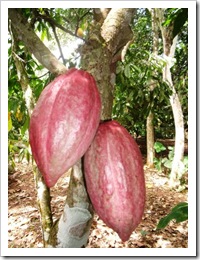
After our interviews, Juliet and Richard (sister and brother) took us through their farm. The main focus was on cocoa farming, but interspersed throughout were plantains, oranges, cassava and palm. The tallness of the plantain trees provided shade for cocoa seedlings, while the combination provided diversification: additional food and cash crops and improved soil fertility. As their smiles show, they were amazingly sweet, generous and kind people, who appreciated the fact that we were continually amazed by the fact we were standing in a cocoa plantation. It was pretty neat to be standing next to a cocoa tree, to taste the fruit (which tastes like a super fruity Jolly Rancher), to taste the dried seed (in which you can taste the beginnings of super dark chocolate), and then to fantasize about what chocolate would taste like.

We asked the farmers if they had ever tasted chocolate. They had. Once. The wanted us to send some to them. To them, cocoa is just a crop. They don’t know the multi-million-gazillion dollar market chocolate is. If they fully understood, maybe they would want more than just the little added bonus they get due to fair trade. I don’t know.

DSCF7227 DSCF7165

There’s a lot more to the co-op and to fair trade, but I’ll just let you wait for Claire to assemble her video. I was paying attention, but not enough to accurately capture it all here. I’ll let you wait for Claire’s video for that. However, I will comment that, to me, the existence of fair trade premiums, the need to essentially give a financial handout to farmers so that they can ‘survive’, indicates that there is something askew in the way global commodities markets operate. There seems to be a huge imbalance between the commodities and consumer markets, and while I’m not an economist, this is something I need to think about further.

Anyway …

After we passed back to the office, and said our thanks that paralleled an elephant in size, we returned tired and happy to our hotel. The day was closed with a healthy dose of internet and pizza. How perfect.

Saturday: Shopaholic in Ghana

Saturday morning we were lazy. We slept in. We did nothing. We enjoyed it.

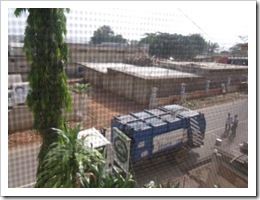
A marching, brass band passed down the street. Whoa! Where am I? There was a real garbage truck out side. Really? Wow. Evidence of being in a city!
DSCF7274

I know that I have openly confessed my dislike of markets, yet for some reason I was very excited to go shopping. I came to Kumasi with the intent of going shopping (well, and to see cocoa). I had one goal: pre-fabricated, very cute dress.

As we headed to the market I continued to be wowed and in love with Kumasi. Seriously, don’t know what it is about the city. It was almost the same way I felt when I was in Paris last year, and yet they are so different.

I came away with: a hefty supply of necklaces, two dresses and 11 yards of fabric. I could have, would have kept buying fabric, but I told Claire to cut me off. She did a good job of enforcing the policy. Little does she know I’m planning to buy more at Lawra Market this week and/or head to Wa on the weekend.

Overall, the market was insanely busy, crowded and just plain crazy. If I wasn’t there for a purpose, I would have probably assumed my usual market freak-out, but fashion and textiles soothed me. In 1995 a good portion of the market was destroyed by fire. I hope that this happened when it was closed, because if fire broke out during the day, I don’t even want to imagine what the stampede would have been like/how many people died/were trampled.

DSCF7307

After market we went back to the hotel to continue being lazy. We eventually went out to dinner, followed by more laziness that night. Nice!

Sunday: Church and Christmas Music

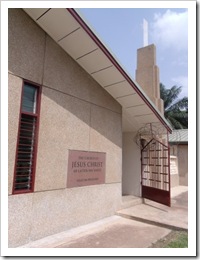
I’ve attended church in Lawra a couple of times, but nothing is ever quite as sweet as attending your own church. I am a member of The Church of Jesus Christ of Latter-day Saints, which is in Ghana, but only in the south (for now). Consequently, I haven’t attended one of “my own” services since July. I was seriously excited for this opportunity to attend! Funny, because I don’t think I’ve ever experienced this much excited for church in my entire life.

Since the other girls had to head back to Tamale/Bolga Sunday morning, a friend kindly came up from Accra came up to keep me company/safe in the big city. So, we said goodbye to Nadia, Carissa and Claire, and headed to church. We didn’t want to be late, so instead we ended up really early. We sat outside the building for awhile listening to the prelude music (playing automatically from the keyboard), then went for a short walk around the area. Beautiful area!

The meetings were in a combination of Twi and English. So, I understood some parts, others I understood by intuition, and others, well, no clue. As it turns out, one member of the ward actually attended University of Toronto, while a good friend of the missionary from Las Vegas is currently serving a mission in Calgary. It is a small world indeed!

I needed to collect some materials from the missionaries, so it meant we had to stick around for the baptism after church too. Three people were getting baptized. I did feel kind of bad for adding another 45 minutes onto the church experience for my friend. But hey, he got to experience something new.

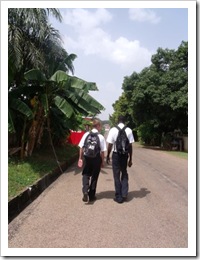
When I was taking the photo of the two missionaries below, the third missionary (there are a total of 6 based in this ward) I was walking with laughed. I explained to him the universal appeal / comfort of this picture to me. It is true. One of my American (non-Mormon) friends from Arizona has commented to me that even to him there is a sense of “home” in seeing the Elders walking around Ghana.
DSCF7337 DSCF7340

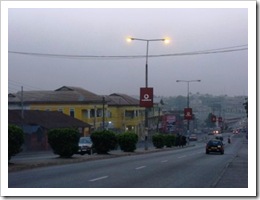
After church we headed back to our area of town, in a mad search for food. In Ghana, most things are closed on Sunday. Fortunately we found a fast food stall (don’t think North American fast food, think rice, pasta, sauces) and greedily ate our first meal of the day (still not quite sure why we didn’t take breakfast on the way to church). After a short rest we decided to wander the city. We didn’t have a plan, but it was kind of fun to just walk, randomly choose left or right at each junction. (Hmm, seems to be a common approach to my travels these days).
DSCF7366

At one point a group of small boys ran up to us for a snap. These boys spied us from across a 4-lane divided road, and raced over, jumping the median barricade, just get a picture.

DSCF7363

As the sun set we neared the Kejetia Market area. I wasn’t sure what to expect as it was a Sunday evening. I was thinking it would be empty. Nope. Just as busy as on Saturday afternoon! The streets were lined with sellers operating by candlelight. On more than one occasion we passed by a music seller playing reggae Christmas music; awesome!

Once we were safely out of the market area, my friend informed me that he thought there was a guy who had been tracing us, which is why he led us on a winding path and we crossed the street multiple times. The market, particularly at night, is known for thieves and pickpockets. We had made sure our small money, camera and phones were carefully stowed away in front pockets. (Don’t worry, if I was alone, I wouldn’t have ventured out at night, especially not to Kejetia). I’m glad he had noticed this, because I hadn’t.

Monday: Back to the North I Go

5 am alarm. Sigh.

Taxi to Metromass Station.

Wait for 2nd bus. First bus already left. Sigh.

650 am. Get on bus. Sigh.

Leave city. Sigh.

Watch the green fade into brown and bush fires. Sigh. Cough. Achoo.

Switch buses in Wa.

More bush fires. Achoo.

410 pm. Walk into my home. (Good) Sigh.

Missing Kumasi, but it’s always nice to be home again (and to take that post-travel shower).

Tuesday: No Place Like Home

800 am: Alarm goes off (a little sleep-in to recover from my travels)

815 am: Lights go out

900 am: Cell network goes down.

Yup, I’m back in the Upper West.

Note: For more photos from this weekend, please see the previous post “Photos from Kumasi”

Monday, November 23, 2009

Photos From Kumasi

Link to album from my weekend in Kumasi (aka The Garden City of Ghana/West Africa, that completely stole my heart) … a more detailed post to follow at some point, although not quite sure when…

http://www.facebook.com/album.php?aid=172521&id=641571969&l=923cdd6c9d

It’s hard to believe I only have two more weeks left in Lawra, and SO much to do! Reports (procrastination is BAD!), shopping, packing, goodbyes …

Monday, November 16, 2009

Ghanaian English – A Second Installment

“Are you having <a product?> – Example usage: “Are you having coco?” said to a lady with a giant pot at the side of the street, meaning, “Are you selling coco (porridge)?”

“How?” – “How are you?” I guess in a hot climate it takes too much energy to finish the sentence.

“How is it?” – How are you?/How’s life? (The correct answer, of course, is “Fine.”)

“Garden” – Example usage: “Do you have a garden?” “How is your garden”. Not getting it? Don’t worry, neither did I at first. A metaphorical garden in Ghana is your collection of boyfriends or girlfriends on the side, outside of your primary relationship.

“How were you handled last night?” – Yeah, just let your mind wander where ever it wants to, that’s exactly what they’re asking you.

“Axe”, used as a verb – to become angry with and discarded as a friend. Example usage: Someone said to me, “I thought you axed me” after I failed to reply to a text message that may have been misinterpreted.

“No, please” – No, thank you. Note: If someone asks you if you want something and you just say please, they will look at you blankly. Because of the usage of “no, please”, you must distinctly say “yes, please” if you want it.

To Kill a Fowl, Act 2

How many posts about birds can write in a week?

Saturday morning there was a knock at my door and I was told to bring my camera. I came outside and my neighbor is proudly holding a guinea fowl. He had been given the fowl by a friend and informed me that I was going to slaughter it. I agreed.

Tony helped me by arranging the bird on the ground, showing me where to place my foot on its wings. He (the bird, not Tony) started squawking and flapping a little. City-girl instinct: scream and jump back. I get recomposed and repositioned and take the knife.

Um … where do I cut? Tony holds the neck and guides my knife to the right position.  After saying sorry to the bird, I tried, but couldn’t get the knife through the skin. Tony takes over, then admits that the knife was incredibly dull, as he struggle a little as well.

So, in the end, I failed to kill a bird yet again.

Note: This entire event was filmed, but unfortunately, I accidentally deleted the video (along with everything else on my memory card!)

Saturday, November 14, 2009

Feathered Friends (?)

Friday afternoon, 4:00 pm. I was tired of being at work for the day and decided it was time for me to leave.

I sit on my bicycle chatting with my colleagues, who were hanging out under the car park, for awhile. It is in these end of day conversations that I learn interesting things.

A mother bird started to chase her chicks around, leading them to swarm my feet (I was wearing sandals). I watched them intently, not realizing that I have now unconsciously raised my feet so just my toes are touching the ground.

Director: “You’re more interested in the birds than us now?” Probably recalling the time I was distracted by the newborn goats when I was supposed to be taking pictures of crops.

Me: “Umm …” still focused on watching the birds, not really able to form a proper sentence.

Director: “You’re afraid ?!?”

Me: “Um...”

So once again, I am teased about fowl … especially given that the veterinary officers was there.

Sigh …

Anyway, I told them that the first step to overcome a fear was admitting that it existed, and I have done so …

Director: “I think I might have to give you a special assignment. Next time Veterinary goes out to do poultry vaccinations, I think you’re going to have to go with him. You can chase the birds, grab them and give them their vaccinations”.

Me: Nervous laughter.

Veterinary: Genuine laughter.

I hope this doesn’t come to pass.

Wednesday, November 11, 2009

Yup, Still Afraid of Fowl

Ok, so I didn’t kill the chicken myself. My excuse was that it was getting dark and so my neighbor had to get the job done fairly quickly. (We live in a little strip of apartment-type housing, and really, don’t have anywhere to keep a chicken). And so, I watched from a safe distance. It was quite impressive the skill and speed from which the chicken went from the live state to being boiled in a pot. As he was gutting it, he paused to give me a quick biology lesson on all the innards. Laughing, I reassured him that this was the part I knew and understood.

My neighbors couldn’t believe that yesterday was my first day ever touching a live chicken (I’m pretty sure I never touched any of the animals at Butterfield Acres when I went as a child) or witnessing the death of one. It’s not that I’m traumatized by the process, I’m just not comfortable with things that have fur or feathers. Lizards and snakes are ok; goats and chickens are not. Don’t even like cats, dogs, rabbits or hamsters.

In the end, I was told that I should buy a chicken and kill it before I leave Ghana. I know Jody and Carissa did this. I know people in Canada who raise and kill their own chickens. I’m not sure though, I’m thinking I might just stick to Lillydale.

p.s. It tasted good.

Market Moments

I will be honest. I don’t like markets. I never have, I don’t think I ever will. I’ve never been to St. Lawrence Market, rarely to Kensington Market, and I avoid Chinatown at all costs. When travelling I’m not tempted by bazaars and kiosks. I even have a hard time handling department stores. I am looking forward to the anonymity and simplicity of shopping at Sobey’s once again. 

That said, I have had a few good “market moments” in Ghana, some leaving me laughing, some leaving me mad, and some, well, just good lessons learned.

Market Moment #1

While Sam was still in Lawra we would go to market together each week. One week we were sitting small and taking some bean cakes (as I lapse into Ghanaian English …), he asked me if there was anything else I wanted to buy. Wanting to get some clothes made, I said, yes, fabric. And then, thinking nothing of it, I resumed eating. I vaguely took note of a lively conversation Sam has was having with women sitting nearby.

When we finished eating, Sam led me to an area of the market, pointed to a table which had a giant pile of socks and men’s underwear on it, and instructed me to look there. Confused, but not really getting what was going on, I said, no, I need fabric and then led him to where the cloth sellers were.

A few days later we were eating dinner and Sam started to randomly laugh. He asked me if I saw a lady hit him at the market while we were eating bean cakes. I said, no, but it looked like you were having a strange conversation. He responded, “Oh, ok, never mind then.” To which I chided him that he can’t start a story and not finish it. After several minutes of begging, he finally told me the story.

So, instead of hearing that I wanted to buy fabric, he somehow got that I wanted to buy a bra. But, in Ghanaian modesty, a – had no clue where in the market to do so, and b – was too embarrassed to ask. He was trying to ask the ladies where he could find one without using any words to directly describe what the product was, or where it was used, in either English or Dagaare. By indirectly describing the product, accompanied with a few gestures, I guess he got a couple of ladies laughing at him and hitting him.

Market Moment #2

When I go to market I take a reusable shopping back, to consolidate all my purchases into one, easier to manage parcel for my often precarious bike trip home. Despite attempting to shop from heaviest to lightest, I usually end up having to stop and take things out and reload with each purchase so as to not squish my tomatoes or burst a bag of groundnut paste. One day I was buying rice, and so squatted down to sort and rearrange my bag. Two ladies quickly rushed up to me, pulled me up and pulled down my shirt.

When I squatted down, my jeans were a little too low, my shirt a little too high. I was “showing off everything that was important”.

Market Moment #3

Because of my dislike of the market atmosphere, I have gotten it down to a system. I can be in and out with a bundle of food I can barely carry home in 10 minutes. Unfortunately, this is not how the Ghanaians do it. Market is a central piece of their culture, especially for the women. After several weeks in a row of my mad market dash, I ran into a few ladies on the street, and proceeded to get into a lot of trouble from them for failing to visit them at market. Alas, my market approach has been slightly modified now. I do a quick “visit circuit”, then an even quicker “shop” circuit …

Market Moment #4

In Canada I would often buy apples, to only have them sit in my fridge for far too long. Here, I can’t seem to get enough of them. Buying apples involves me going to Wa, and so when I go, I buy more than one. I know apples are 50 pesewa each, but I always ask the seller, just to make sure we are on the same ground. (There is the odd person who will try to sell them to you for 70psw). I ask for somewhere in the neighborhood of 40,000 (GHC4). Really, buying 8 apples shouldn’t be a big deal, but they never seem to understand that I actually want that many apples. If I ask for 40,000, they’ll usually put 4 in the bag, thinking the white lady doesn’t know what she’s asking. I encourage them to keep adding, more, and eventually, they realize that I was serious about buying 8 apples, and are happy with the sale.

I guess one positive thing about buying apples (or any produce) is that it is a price per unit, rather than pound. I’m sure we’ve all been surprised to get to the checkout and realize we mistakenly read the sign and the apples we selected were $1.99/lb, rather than $1.29!

Tuesday, November 10, 2009

You know you have good neighbors when …

… you get dropped off at home from work, with a live chicken, and you can knock on their door in a state of panic. Then, after they (sort of) finish laughing, they take it from you and say “Go shower, we’ll call you when it is time to kill it.”

Just showered, stay tuned for more details …